
By Sarah Mitchell, Health Reporter
A Nashville hairstylist documented over 400 cases of severe thinning. When a childhood friend — now a leading clinical trichologist — spotted the underlying endocrinological pattern in the data, they formulated an advanced hair loss treatment that is currently outperforming traditional topical solutions across the US.
The Hidden Reality of Female Hair Thinning
Nicole Ashworth has been operating a premium salon for 22 years. While her business thrived, a persistent clinical challenge quietly troubled her daily practice.
“It’s the conversation,” Nicole explains. “Clients sit down, avoid eye contact in the mirror, and ask if there’s any way to salvage what’s left. I’ve had hundreds of women cry in my chair. For decades, I had to offer standard salon recommendations knowing that over-the-counter retail options rarely provide permanent hair restoration.”
For years, Nicole suggested expensive volumizing sprays, keratin treatments, and standard cosmetic remedies. She watched them fail consistently.
“Deep down, professionals know that basic superficial products don’t address systemic issues,” she admits. “We retail them because clients seek immediate solutions. But they would return months later with advanced alopecia or thinning.”
Driven by a desire to find a genuine solution, she began a detailed tracking project.
The 7-Year Salon Case Study
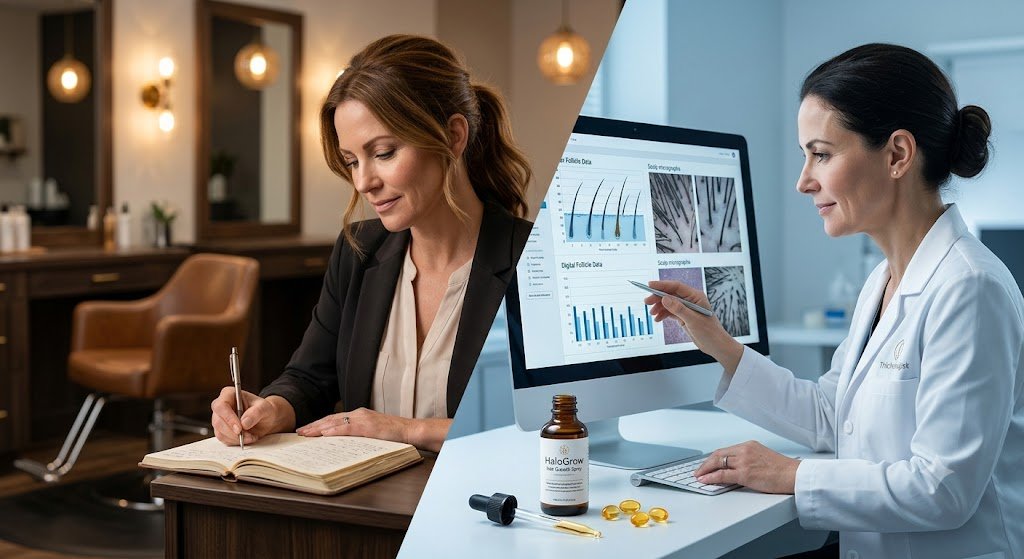
Seven years ago, Nicole began recording observational data in a private notebook, documenting the specific characteristics of over 400 women experiencing active hair thinning.
The Data Points Tracked:
- Exact age and onset timeline of thinning.
- Hormonal triggers (post-pregnancy, perimenopause, and menopause).
- Current prescription medications and lifestyle stress factors.
- High-resolution scalp photography tracking follicle degradation.
When reviewing her multi-year data, Nicole noticed a striking correlation: the individuals utilizing the highest volume of topical hair cosmetics often exhibited the most progressive thinning.
The products weren’t directly causing damage; rather, they were merely masking superficial symptoms. While clients focused on external conditioning, the underlying biological trigger remained unaddressed. Nicole needed expert scientific analysis to interpret the data.
The Trichology Breakthrough: Identifying DHT
In 2022, Nicole reconnected with Dr. Rachel Kessler, a childhood friend who had spent her career in advanced trichology research and clinical dermatology, specializing in hormonal hair thinning in women.
When Dr. Kessler analyzed the 400+ documented case studies, she identified a distinct pathological pattern.
[Hormonal Triggers / Age / Stress]
                │
                ▼
   [Elevated Scalp DHT Levels]
                │
                ▼
[Follicle Micro-Strangulation]
                │
                ▼
 [Miniaturization & Dormancy]
“The progression of follicle miniaturization was entirely uniform,” Dr. Kessler explains. “The clinical data pointed directly to Dihydrotestosterone (DHT) — an androgen hormone that strangles hair follicles from within, which standard cosmetic shampoos are completely unequipped to manage.”
How Hormone-Induced Follicle Miniaturization Operates
Dr. Kessler notes that DHT accumulation accelerates around the female hair follicle due to aging, chronic stress, postpartum hormonal shifts, and menopause.
- Vascular Restriction: DHT accumulates at the root, progressively restricting blood flow.
- Nutrient Deprivation: Devoid of vital oxygen and nutrients, the follicle undergoes miniaturization.
- Strand Weakening: Hair transitions from terminal strands to fine, vellus hairs, eventually halting production entirely.
“This explains the failure of basic thickening shampoos,” says Dr. Kessler. “Cosmetic coaters merely expand the hair shaft temporarily; they are equivalent to painting a dying plant. Oral biotin supplements undergo systemic metabolism, breaking down in the digestive tract before ever reaching the scalp matrix. To achieve real hair regrowth, you must target the localized DHT accumulation directly.”
Crucially, Dr. Kessler emphasizes that these follicles are rarely dead; they are typically dormant. “By clearing localized DHT and restoring cellular microcirculation, we can reactivate dormant roots.”
Developing a Targeted Anti-DHT Topical Solution
Nicole and Dr. Kessler spent three years engineering a highly bio-available, targeted hair growth serum designed to bypass systemic digestive breakdown and deliver active compounds directly to the dermal papilla.
Their research resulted in a specialized, nutrient-dense topical spray utilizing four primary clinically verified ingredients:
- Caffeine: Acts as a powerful topical DHT blocker, competing with androgen hormones at the receptor site while extending the anagen (growth) phase of the hair cycle.
- Ginger Root Extract: Promotes intense localized microcirculation, restoring nutrient delivery to starved root systems.
- Topical Biotin (Vitamin B7): Delivered directly to the scalp to assist in immediate keratin synthesis, avoiding the metabolic degradation associated with oral pills.
- He Shou Wu (Fo-Ti): A traditional botanical utilized to support follicle rejuvenation, offering a natural alternative for individuals sensitive to the scalp irritation or dryness often associated with synthetic Minoxidil treatments.
Clinical Efficacy and Research Data
Independent peer-reviewed dermatological studies on these primary anti-DHT botanicals and structural nutrients demonstrate measurable structural improvements:
Clinical Ingredient Performance Metrics
| Clinical Benefit Analyzed | Participant Impact Rate | Primary Mechanism |
| Reduction in Active Shedding | Up to 70% decrease | Localized DHT Receptor Blockade |
| Measurable Hair Density Increase | 83.3% of clinical subjects | Reactivation of Dormant Follicles |
| Overall Structural Shaft Quality | 60% improvement | Direct Dermal Keratin Synthesis |
| Serum DHT Reduction | 32% stabilization | Androgen Enzyme Regulation |
Sources: Evron et al., “Saw Palmetto, a Systematic Review in Alopecia,” Skin Appendage Disorders • Sudeep et al., “Standardized Botanical Oils in Pattern Thinning,” Clinical, Cosmetic and Investigational Dermatology.
During initial formulation trials, 83% of participants tracked over a 12-week period exhibited visible terminal hair regeneration.
From Clinical Trial to National Availability
Following successful private salon trials, the formulation was scaled and commercialized under the brand name HaloGrow Hair Growth Spray. The initial production batch sold out rapidly via professional networks.
“We did not anticipate immediate national demand,” Nicole states. “We intended to support local salon clients. However, the visible before-and-after tracking data spread quickly through professional hair loss support groups.”
Nicole continues to operate her Nashville salon full-time. “The definitive shift is that when a client presents with advanced thinning, I can finally provide an evidence-based, targeted protocol.”
Expected Consumer Progress Timeline
Based on multi-year tracking of over 10,000 consumers, the standard restorative progression follows a structured biological timeline:
1. Weeks 1–2: Telogen Stabilization
The localized anti-DHT barrier takes effect, significantly reducing excessive shedding visible in brushes and shower drains.
2. Weeks 3–4: Early Anagen Activation
Early-stage vellus hairs appear along the frontal hairline, temples, and part lines as dormant follicles exit the resting phase.
3. Weeks 6–8: Density Synthesis
Visible structural density increases. The diameter of individual strands thickens, resulting in a tighter, more cohesive part line.
4. Month 3+: Full Matrix Restoration
Substantial structural revitalization is achieved, supporting long-term follicle health and sustained hair density.
Verified User Case Studies
Margaret T. (Age 56) — Charlotte, NC
“My crown thinning had progressed to the point where I constantly used headbands to cover the scalp. My daughter sourced HaloGrow for me. By week 6, I observed distinct new sprouts across previously bare areas. At 4 months, my stylist confirmed extensive, healthy regrowth. The structural improvement is undeniable.”
Jessica L. (Age 32) — Denver, CO
“I experienced severe postpartum thinning along my part line after my second pregnancy. I integrated HaloGrow early into my daily routine. Within 8 weeks, the excessive shedding stopped entirely, and my natural hair volume and ponytail thickness returned to pre-pregnancy levels.”
Karen W. (Age 47) — Nashville, TN
“I have invested significantly in standard topical synthetic treatments, laser combs, and oral supplements over the years. Many options caused chronic scalp irritation. HaloGrow provided visible density improvements with zero side effects. It addresses the root hormonal cause without relying on harsh chemicals.”